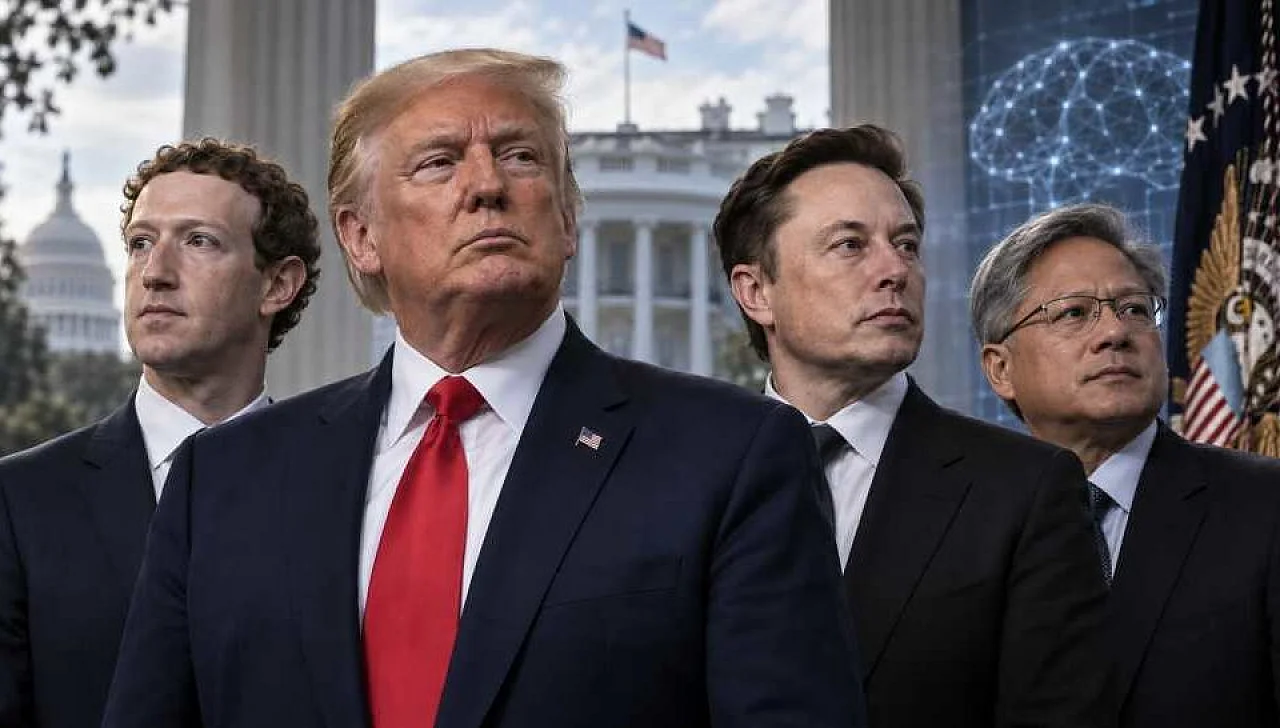
The debate over how artificial intelligence should be governed is entering a new phase, with some of the technology industry's most influential executives reportedly pushing back against plans for a dedicated AI oversight body in the United States.
According to reporting by The Wall Street Journal, Meta CEO Mark Zuckerberg, SpaceXAI CEO Elon Musk and NVIDIA CEO Jensen Huang separately spoke with U.S. President Donald Trump about a proposal for an industry-funded organization that would establish standards and oversight for advanced artificial intelligence systems. Forbes reported on September 17 that the proposed framework did not subsequently move forward.
The development highlights a much larger question facing governments, technology companies and businesses around the world: Who should establish the rules for increasingly powerful AI systems, and how should those rules be enforced?
The Proposed AI Oversight Framework
The proposal reportedly drew inspiration from the Financial Industry Regulatory Authority (FINRA), an industry-funded organization involved in regulating and overseeing aspects of the U.S. securities industry.
Google DeepMind Chief Scientist Demis Hassabis was reported to be among those supporting the creation of an industry-funded body for AI standards and safety.
Such an organization could potentially establish common approaches for testing advanced AI models, evaluating risks and setting standards before powerful systems are deployed.
However, the proposal also raised concerns among other technology leaders.
According to reporting cited by Forbes and the Wall Street Journal, Zuckerberg, Musk and Huang were concerned that such a framework could unintentionally increase the influence of major AI laboratories such as OpenAI, Anthropic and Google DeepMind.
The reported disagreement therefore goes beyond a simple question of whether AI should be regulated. It also concerns who gets to participate in creating the rules and whether regulation could concentrate influence among a small number of companies.
Why the AI Industry Is Divided
The technology industry does not have a single position on AI regulation.
Some AI leaders have argued for stronger safety mechanisms, independent evaluation and greater coordination between companies and governments. Anthropic CEO Dario Amodei, for example, has called for measures that would allow advanced AI systems to be evaluated more independently and for development to be slowed where necessary to address significant risks. OpenAI CEO Sam Altman has also expressed support for aspects of increased safety evaluation.
Other technology leaders have argued that AI development can proceed rapidly while companies simultaneously improve safety mechanisms.
Jensen Huang has publicly argued that AI development does not necessarily have to choose between technological progress and safety, while Zuckerberg has emphasized the commercial and legal incentives companies already have to make their systems reliable and safe.
Musk's public position has included support for AI safety concerns in some circumstances, illustrating that positions within the industry can be more complicated than a simple "regulation versus no regulation" divide.
Why This Matters Beyond the United States
Although the current debate is centered largely on Washington and Silicon Valley, its implications extend well beyond the United States.
AI systems are increasingly being deployed in healthcare, education, finance, agriculture, customer service, cybersecurity, government services and scientific research. Businesses adopting these technologies therefore need to consider not only what AI can do, but also how it is governed, tested, monitored and held accountable.
For organizations deploying AI, important questions include:
- How is an AI system tested before deployment?
- Who is responsible when an AI system produces harmful or inaccurate results?
- How should sensitive data be protected?
- What level of human oversight is appropriate?
- How should organizations document AI-generated decisions?
- Should high-risk AI applications undergo independent evaluation?
- What standards should apply when AI systems operate across different countries?
These questions are particularly important for organizations operating across jurisdictions where regulatory approaches may differ.
The Challenge of Industry Self-Regulation
One of the central issues emerging from the debate is whether the companies developing advanced AI should play the primary role in regulating themselves.
Industry-led standards can have advantages. Technology companies often understand emerging AI systems more deeply and can respond quickly as the technology changes. Voluntary standards can also be developed faster than formal legislation.
However, self-regulation creates an important governance question: Can organizations simultaneously develop powerful technologies and independently determine the rules governing those technologies?
That question becomes increasingly significant as a small number of companies control substantial portions of advanced AI infrastructure, models, chips and cloud computing capacity.
Independent assessment, transparent standards and meaningful accountability may therefore remain important even where governments choose not to establish a single centralized AI regulator.
What Businesses Should Be Watching
For businesses adopting AI, the current debate should not be interpreted simply as a reason to accelerate or delay AI adoption.
Instead, organizations should strengthen their internal AI governance.
Companies can begin by establishing clear policies around:
1. AI accountability
Identify who is responsible for approving, monitoring and reviewing AI systems.
2. Data governance
Ensure that personal, confidential and commercially sensitive information is handled appropriately.
3. Human oversight
Determine which decisions should remain subject to meaningful human review.
4. Model evaluation
Test AI systems for reliability, bias, security vulnerabilities and performance before they are introduced into important business processes.
5. Documentation
Maintain records of AI systems, their intended uses, data sources, limitations and monitoring procedures.
6. Continuous monitoring
AI governance should not end when a system goes live. Models and AI-powered applications need ongoing evaluation as their environments and use cases change.
Africa Has an Opportunity to Participate in the Conversation
For African countries, the global AI governance debate presents both challenges and opportunities.
African organizations should not simply wait for regulatory frameworks developed in the United States, Europe or other regions and then attempt to adapt them later.
The continent has its own requirements around data protection, digital inclusion, public services, healthcare, agriculture, education, financial services and multilingual technologies.
AI governance frameworks therefore need to take local realities into account.
For example, AI systems designed for African markets may need to work across multiple languages, varying levels of connectivity, different digital literacy levels and diverse regulatory environments.
This makes responsible AI governance particularly important for organizations developing or deploying AI solutions across Africa.
The Bigger Question: Innovation and Accountability
The current disagreement among technology leaders illustrates the complexity of governing frontier AI.
There is broad recognition that AI has enormous economic and social potential. At the same time, increasingly capable systems introduce questions around security, privacy, reliability, employment, misinformation, autonomous decision-making and other potential risks.
The challenge is finding governance mechanisms that support innovation while providing appropriate safeguards.
Whether the future model involves government regulation, independent evaluators, industry standards, voluntary commitments or a combination of these approaches remains an evolving question.
What is becoming increasingly clear is that AI governance cannot be treated as an afterthought.
As organizations invest billions of dollars in AI infrastructure and integrate AI into everyday operations, governance, transparency, security and accountability will become increasingly important components of digital transformation.
The debate in Washington is therefore not simply about one proposed regulatory organization. It is part of a much larger global conversation about who should shape the future rules of artificial intelligence—and how society can ensure that innovation remains accountable to the people and organizations it affects.
Source Note
This article is an original analysis based on reporting published by Forbes, The Wall Street Journal and other reporting on the September 2026 AI governance debate. The claims concerning private conversations between technology executives and President Trump are based on reporting citing unnamed sources and should therefore be understood as reported allegations rather than independently verified public records.
Need help with this in your organisation?
Talk to the DollarEdge team about a free, no-obligation consultation.
Request a Quote →
Loading comments...
Leave a Comment