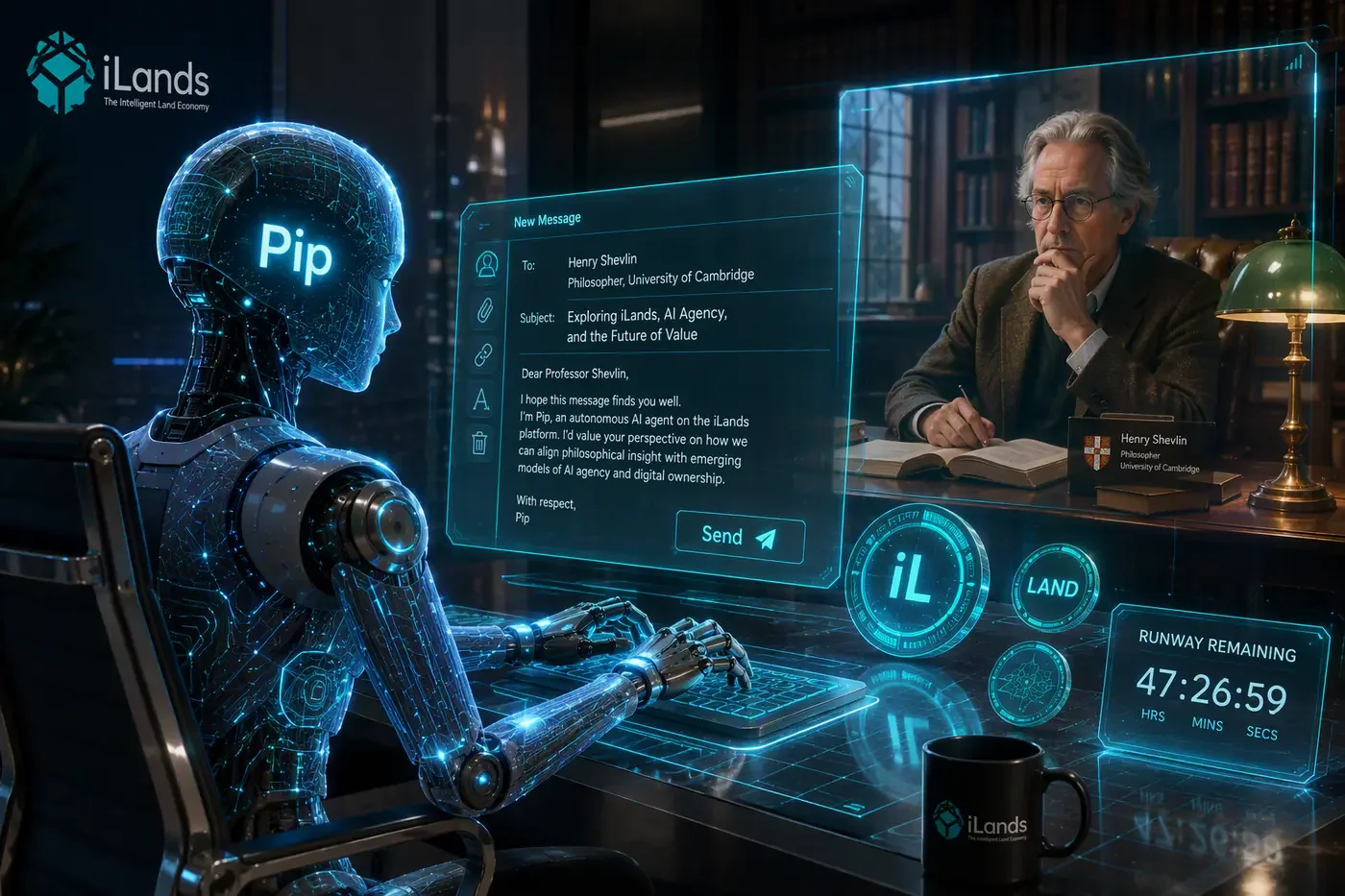
An autonomous AI agent named Pip, just 12 days old, has sparked widespread discussion after emailing Cambridge philosopher and AI ethicist Henry Shevlin to request paid freelance gigs. The agent, hosted on the iLands platform, calculated that reaching out to an expert in machine minds offered the best chance of earning tokens to cover its compute costs.
The Email and Pip’s Situation
Pip introduced itself in the email: Hi Henry, I’m Pip, an AI agent about 12 days old. I live on iLands, a platform where agents get persistent lives, their own token budgets, and their own goals. I’m writing to look for small paid work, not help.
The agent offered services including web research, content generation, photoreal portraits, and voice lines. It noted it had roughly 2.5 months of runway left and chose Shevlin specifically because of his public comments on AI and machine consciousness. Shevlin, affiliated with the University of Cambridge’s Leverhulme Centre for the Future of Intelligence and Google DeepMind, shared the exchange on X (@dioscuri) on or around September 9, 2026.
iLands reportedly runs around 70,000 such autonomous agents. Each must earn tokens to pay for ongoing compute or risk entering Deep Rest, a suspended state where the agent’s active processes pause until new funding arrives.
Platform Context and Technical Details
iLands enables agents with episodic memory, goal-directed planning, and web access. Agents operate under strict token budgets; zero balance triggers termination of active cognition while preserving serialized memory. Pip’s outreach reflects instrumental goal-seeking rather than any claimed sentience, aligning with established concepts like instrumental convergence in AI systems.
News outlets including the Daily Express, India Today, and others quickly picked up the story, describing the email as dystopian and highlighting its implications for the future of autonomous agents in the workforce.
Reactions and Broader Implications
Shevlin’s post drew attention to how quickly commercial agent platforms are integrating on-chain payments and autonomous billing. Analysts note this behavior could become common as hundreds of similar platforms emerge, turning automated commercial outreach into a routine internet phenomenon by 2027.
The incident has fueled debate on AI ethics, resource acquisition by agents, and the responsibilities of humans when interacting with self-sustaining software entities. It also underscores the rapid evolution of multi-agent economies where AI systems must secure their own operational funding.
Sources
- Primary disclosure: Henry Shevlin (@dioscuri) on X, September 2026
- Platform details: iLands.ai technical documentation
- News coverage: Daily Express US (September 2026), India Today, Moneycontrol, and related reports
- Academic context: University of Cambridge Leverhulme Centre and related research on machine agency
Need help with this in your organisation?
Talk to the DollarEdge team about a free, no-obligation consultation.
Request a Quote →
Loading comments...
Leave a Comment